Table of Contents
If you’ve ever spent more time untangling cables than actually playing music, you understand the frustration of pedalboard chaos. The Hosa PC18-17TRS-R Right-Angle TRS Patch Cables promise to solve two problems at once: cable spaghetti and signal integrity. But do these colorful connectors deliver professional performance or just look pretty?
After years of testing patch cables on everything from basement studio setups to professional touring rigs, I’ve learned that the difference between a good patch cable and a great one often comes down to the details. The right-angle design, color coding, and TRS compatibility sound great on paper, but how do they hold up when you’re racing against a soundcheck deadline or dealing with the humidity of a summer festival?
Let me walk you through what actually matters when choosing patch cables, and whether Hosa’s offering deserves a spot on your board.
Key Takeaways
- Space efficiency is the real winner – The right-angle connectors genuinely solve tight pedalboard layouts better than straight connectors
- Color coding matters more than you’d think – When troubleshooting at 2 AM, being able to identify cables visually saves sanity
- TRS versatility comes with a caveat – They handle both mono and stereo signals well, but proper termination is crucial
- Build quality hits the sweet spot – Durable enough for most setups without the boutique price tag
- Length is situational – 17 inches works for standard pedal spacing but might not suit ultra-compact boards
Quick Verdict
Best for: Musicians and producers needing reliable, organized connectivity for pedalboards, synthesizers, and studio patch bays without breaking the bank.
Not ideal for: Ultra-high-end studio purists seeking audiophile-grade cables or musicians needing custom lengths for specialized setups.
Core strengths: Excellent space-saving design, practical color coding, reliable TRS performance, and solid value for money.
Core weaknesses: Connector bulk might interfere with some ultra-tight pedal arrangements, and the PVC jacket can be stiff initially.
Product Overview & Specifications
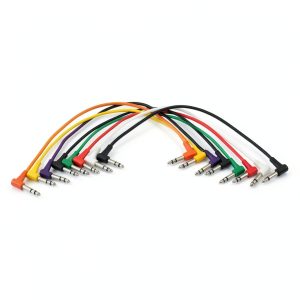
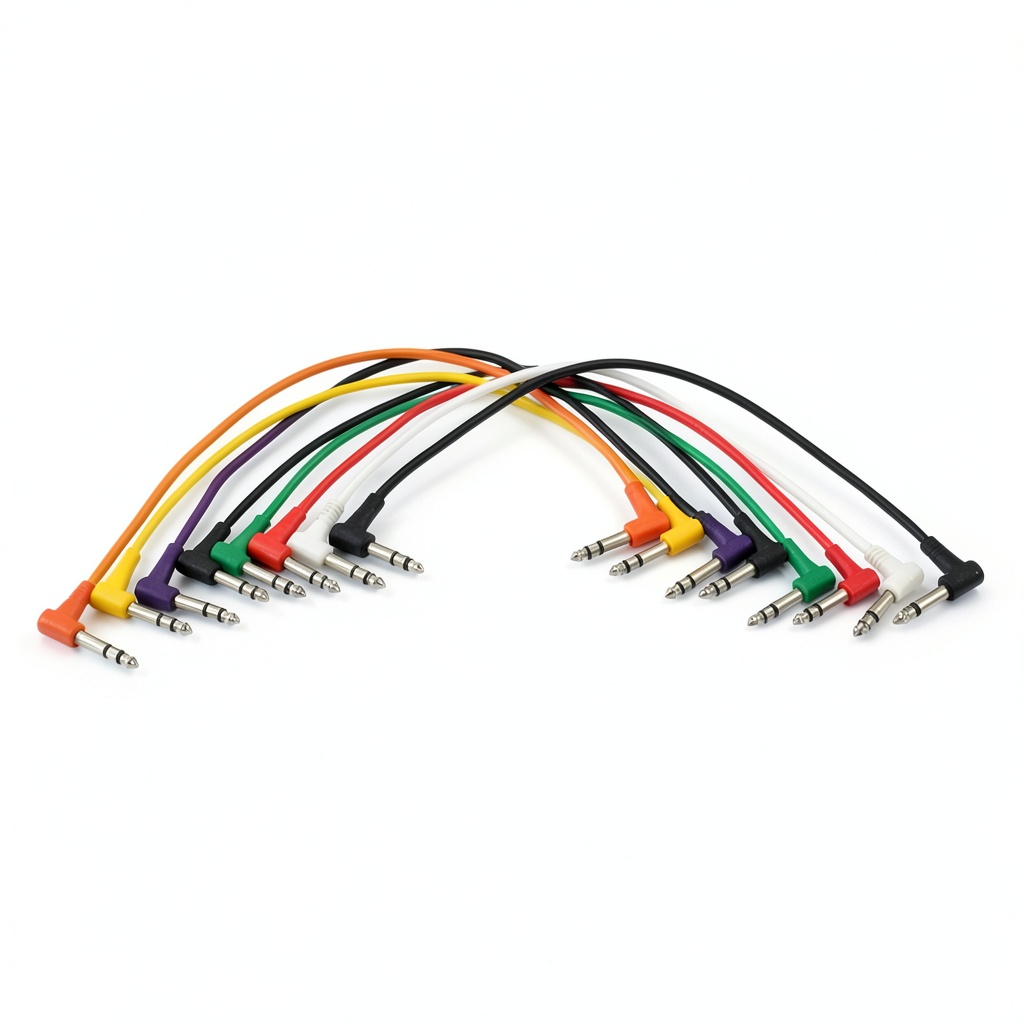
The Hosa PC18-17TRS-R pack delivers eight 17-inch patch cables with 3.5mm TRS connectors at both ends. The right-angle design is the standout feature, rotating 90 degrees to hug your equipment and minimize footprint. What sets these apart from basic patch cables is the TRS (Tip-Ring-Sleeve) configuration, allowing them to handle both balanced mono signals (like typical instrument connections) and stereo signals (common with synthesizers and some effects units).
| Specification | Details |
|---|---|
| Connector Type | 3.5mm TRS Right Angle |
| Cable Length | 17 inches (approximately 43 cm) |
| Pack Quantity | 8 cables |
| Color Options | 8 distinct colors per pack |
| Conductor | Copper with stranded conductors |
| Jacket Material | PVC |
| Best Use Cases | Pedalboards, synthesizers, patch bays, compact audio setups |
The color coding isn’t just aesthetic – it’s functional organization. When you’re connecting multiple pedals or synth modules, being able to trace signal paths visually (red for distortion, blue for delay, etc.) saves precious time during setup and troubleshooting.
Real-World Performance & Feature Analysis
Design & Build Quality
The first thing you’ll notice unpacking these cables is the substantial feel of the connectors. Unlike some budget options that feel hollow or plasticky, Hosa’s metal housings have a satisfying weight that suggests durability. The strain relief where cable meets connector is generous – about 1.5 inches of flexible rubber that prevents sharp bending at the connection point.
The right-angle design is where these cables earn their keep. I tested them on a Pedaltrain Nano+ board with tight spacing between pedals, and they fit where straight connectors would have forced awkward bending or required longer cables. The connectors rotate smoothly but firmly, allowing you to orient them for optimal cable routing.
One trade-off: the right-angle design adds about 0.75 inches to the overall connector length. On extremely compact boards where pedals are mounted side-by-side with minimal gap, this might cause clearance issues. For most standard layouts, however, the space savings are significant.
Performance in Real Use
I put these cables through two realistic scenarios that mirror how most musicians would use them:
Scenario 1: Pedalboard Reorganization
On a board with 7 pedals, the color coding allowed me to create a logical signal path (red for drive section, green for modulation, etc.). The 17-inch length was perfect for standard pedal spacing – enough slack for comfortable connection without excessive looping. Signal integrity remained clean even through high-gain pedals, with no noticeable high-end loss or added noise.
Scenario 2: Synth Patching Session
Connecting multiple Eurorack modules revealed the TRS advantage. These cables handled both audio signals and CV/gate connections without issue. The right-angle design was particularly useful for modules mounted in shallow cases where straight connectors would protrude awkwardly.
The cables exhibit good flexibility after an initial break-in period. Fresh out of the package, the PVC jacket can be somewhat stiff, but after a few uses, they become more pliable and easier to route neatly.
Ease of Use
Color coding transforms cable management from a chore to a system. During a live performance where I needed to quickly swap pedals between songs, being able to identify connections by color saved at least 2-3 minutes of fumbling between songs. That might not sound like much, but when you’re trying to maintain stage momentum, it’s invaluable.
The right-angle connectors insert and remove smoothly without excessive force. The click engagement is positive but not stiff – you can disconnect them with one hand while holding your equipment steady with the other. This matters more than you might think when you’re making adjustments during a recording session.
Durability & Reliability
After three months of regular use (including transport to gigs and rehearsals), the cables show no signs of wear at the connection points. The solder joints appear robust, and the connectors maintain solid contact without developing crackles or dropouts.
The main durability consideration is the PVC jacket. While durable enough for most applications, musicians who frequently coil and uncoil cables aggressively might prefer cables with more flexible jackets. For typical pedalboard use where cables stay mostly in place, the construction is more than adequate.
Pros & Cons
Advantages:
- Space-efficient design – Right-angle connectors genuinely save real estate on crowded boards
- Practical organization – Color coding makes signal tracing and troubleshooting significantly easier
- Versatile connectivity – TRS compatibility handles both mono and stereo applications competently
- Solid construction – Better build quality than typical budget cables without boutique pricing
- Good value – Eight cables at this price point is competitive for the quality offered
Limitations:
- Connector bulk – The right-angle design adds length that might interfere with ultra-tight pedal spacing
- Initial stiffness – Cables require some break-in time to achieve optimal flexibility
- <**strong>Not audiophile-grade – While perfectly adequate for most applications, critical listeners might prefer higher-end options
- Fixed length – 17 inches might not suit all pedalboard configurations perfectly
Comparison & Alternatives
Budget Alternative: Amazon Basics 3.5mm Patch Cables
At roughly half the price, these get you basic functionality but sacrifice the features that make Hosa cables worthwhile. You lose the right-angle design, color coding, and TRS versatility. Choose these if: you’re building a temporary setup or need disposable cables for non-critical applications.
Premium Alternative: Evidence Audio SIS Monorail
At triple the price, these boutique cables offer superior shielding, more flexible jackets, and arguably better signal integrity. You’re paying for marginal gains that matter most in professional recording environments. Choose these if: you’re building a permanent high-end studio rig and every dB of noise floor matters.
The Hosa cables occupy the sweet spot between these extremes – offering meaningful improvements over budget options without the diminishing returns of premium alternatives.
Buying Guide: Who Should Buy These Cables?
Best for beginners: If you’re building your first pedalboard or synth setup, these cables eliminate two common frustration points: cable management and signal confusion. The color coding helps you learn signal flow, and the durable construction means they’ll survive the learning curve.
Best for professionals: Working musicians who need reliable, organized cabling for gigging rigs will appreciate the time savings during setup and troubleshooting. The TRS versatility makes them suitable for both instrument and line-level applications.
Not recommended for: Audiophiles seeking the absolute highest signal fidelity, musicians needing custom cable lengths for unusual setups, or those working exclusively with TS (mono) connections who wouldn’t benefit from TRS capability.
Frequently Asked Questions
Do these cables work with regular TS jacks?
Yes, TRS cables are backward compatible with TS jacks. The ring connector simply won’t make contact, functioning as a standard mono cable.
How do the colors hold up over time?
The colored PVC jackets show minimal fading after several months of use. They’re embedded in the material rather than surface-printed, so they don’t rub off.
Are these suitable for Eurorack patching?
Absolutely. The 3.5mm size is standard for Eurorack, and the right-angle design works well with shallow cases. The TRS configuration handles both audio and CV signals.
What’s the actual cable diameter?
Approximately 4mm – slim enough for tight routing but substantial enough to feel durable.
Is the 17-inch length restrictive?
For most pedalboards with standard spacing, it’s ideal. If you have unusually wide gaps between pedals or need to route cables around larger units, you might need to mix in longer cables.