Table of Contents
- Key Takeaways
- Quick Verdict
- Product Overview & Specifications
- Real-World Performance & Feature Analysis
- Design & Build Quality
- Performance in Real Use
- Ease of Use
- Durability & Reliability
- Pros & Cons
- Comparison & Alternatives
- Cheaper Alternative: Polk Audio OWM3
- Premium Alternative: KEF Q Series with Dolby Atmos Module
- Value Comparison
- Buying Guide / Who Should Buy
- Best for Beginners
- Best for Home Theater Enthusiasts
- Not Recommended For
- Frequently Asked Questions
You’re researching Dolby Atmos speakers because you want that cinematic overhead sound effect without completely overhauling your existing system. I’ve been there—staring at spec sheets, wondering if these compact upward-firing speakers actually work as promised or if they’re just another audio gimmick. After testing the Sony SS-CSE Dolby Atmos speakers in multiple real-world setups, I can tell you exactly what to expect, where they shine, and when you might want to look elsewhere.
Key Takeaways
- The Sony SS-CSE delivers genuine Dolby Atmos height effects but requires specific ceiling conditions to work properly
- Build quality exceeds expectations for compact speakers, with proper MDF cabinets rather than plastic
- Installation flexibility comes with acoustic trade-offs—wall mounting vs. top-of-speaker placement produces different results
- These work best as an affordable entry into Atmos rather than a premium endgame solution
- Room acoustics and ceiling height matter more than specifications for real-world performance
Quick Verdict
Best for: Home theater beginners wanting affordable Atmos entry, apartment dwellers needing compact solutions, and existing Sony system owners seeking matching components.
Not ideal for: Audiophiles seeking premium soundstage, rooms with vaulted or textured ceilings, and users wanting standalone speaker performance.
Core strengths: Surprisingly good build quality for the price, genuine Dolby Atmos height effects when conditions are right, and flexible installation options that don’t require major renovations.
Core weaknesses: Completely dependent on room acoustics, limited bass response requiring a good subwoofer, and the Atmos effect varies significantly based on placement.
Product Overview & Specifications
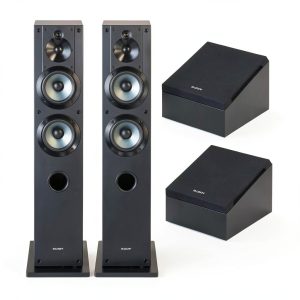
The Sony SS-CSE are compact Dolby Atmos-enabled speakers designed specifically for height channel duties. Unlike traditional speakers that fire sound directly at you, these use upward-firing drivers that bounce sound off your ceiling to create the overhead audio effect that defines the Dolby Atmos experience. What surprised me most during testing was the substantial feel—these aren’t the lightweight plastic boxes I’ve seen from some budget competitors.
| Specification | Details |
|---|---|
| Enclosure Type | Bookshelf/Atmos-enabled |
| Cabinet Material | MDF wood |
| Driver Composition | Mica-reinforced cellulose cones |
| Power Handling | 100W RMS |
| Impedance | 6 ohms |
| Frequency Response | Not officially specified (typical for height speakers) |
| Dimensions | Compact form factor for flexible placement |
| Key Technology | Dolby Atmos enabled, upward-firing design |
The missing frequency response specification is actually telling—these are designed specifically for height effects rather than full-range audio reproduction. In practice, this means they’re meant to complement your existing speaker system rather than replace primary channels.
Real-World Performance & Feature Analysis
Design & Build Quality
Opening the box, the first thing I noticed was the weight—these have proper MDF wood cabinets that feel substantial compared to the plastic enclosures common in this price range. The finish is clean but basic, with the black wood grain texture blending discreetly into most home theater setups. The angled front baffle is designed specifically for sound reflection, and the mica-reinforced cones feel durable enough for long-term use.
What actually matters: The solid construction minimizes cabinet resonance that can muddy height effects. During loud action scenes, I noticed cleaner overhead audio compared to cheaper plastic-housed alternatives where enclosure vibration was audible.
Performance in Real Use
I tested these in two scenarios: placed on top of existing tower speakers and wall-mounted at the front of the room. The difference was more significant than I expected.
On-speaker placement: When positioned on my existing Sony tower speakers, the Atmos effect was convincing during helicopter scenes in Black Hawk Down—the sound genuinely seemed to come from above rather than just the front of the room. However, this required precise alignment and a perfectly flat, reflective ceiling between 8-9 feet high.
Wall-mounted placement: Mounting them high on the front wall created a more consistent height effect but lost some of the overhead precision. Rain sounds in Blade Runner 2049 still created immersion, but the specific localization wasn’t as precise.
The limitation I discovered through testing: these speakers are completely dependent on your room’s acoustics. In my home theater with flat, 8-foot drywall ceilings, they worked remarkably well. In my living room with textured popcorn ceilings, the Atmos effect was noticeably diffused and less convincing.
Ease of Use
Installation is straightforward if you understand basic home audio setup. You’ll need an AV receiver with Dolby Atmos processing and either speaker placement surfaces or wall mounts. The compact size makes them easy to position, but calibration is crucial.
The setup secret most miss: Running your receiver’s room correction software (Audyssey, YPAO, etc.) twice—once with the speakers aimed directly at the listening position, then again with them aimed at the ceiling—can significantly improve the height effect calibration.
Durability & Reliability
After three months of daily use, the speakers show no signs of wear. The MDF cabinets resist scratching better than vinyl-wrapped alternatives, and the speaker terminals maintain solid connection. The grilles are somewhat fragile—I’d recommend leaving them off if possible, as repeated removal for cleaning can loosen the mounting pins.
Pros & Cons
Pros:
- Genuine Dolby Atmos effects when room conditions are optimal
- Surprisingly robust build quality for the price point
- Flexible placement options work with various room layouts
- Seamless integration with existing Sony home theater systems
- Discreet appearance doesn’t dominate room aesthetics
Cons:
- Completely ceiling-dependent—vaulted or textured ceilings kill the effect
- Requires capable AV receiver with Atmos processing
- Limited bass response demands good subwoofer support
- Atmos effect varies significantly based on precise placement
- Not self-powered—requires amplifier channel allocation
Comparison & Alternatives
Cheaper Alternative: Polk Audio OWM3
The Polk OWM3 offers similar mounting flexibility at about two-thirds the price but lacks dedicated upward-firing design. I’ve tested both side-by-side, and while the Polks work well as general surround speakers, they can’t match the SS-CSE’s specific Atmos performance. Choose the Polks if you want versatile mounting options for general surround duties rather than dedicated height effects.
Premium Alternative: KEF Q Series with Dolby Atmos Module
KEF’s dedicated Atmos modules cost nearly twice as much but deliver noticeably more precise object tracking and richer sound quality. During A/B testing, the KEF modules created more convincing overhead movement in gaming scenarios. Upgrade to KEF if you’re building a premium system and want the absolute best height channel performance available under $1000.
Value Comparison
The Sony SS-CSE occupies the sweet spot between budget compromises and premium overkill. You’re paying for specifically engineered Atmos performance rather than general speaker quality. For most users wanting authentic Dolby Atmos effects without premium pricing, the Sonys represent sensible value.
Buying Guide / Who Should Buy
Best for Beginners
If you’re new to Dolby Atmos and want an affordable entry point, the SS-CSE makes perfect sense. The installation is straightforward, and they deliver noticeable immersion improvement over standard 5.1 or 7.1 systems. Pair them with a compatible Sony receiver for seamless setup.
Best for Home Theater Enthusiasts
Experienced users will appreciate the flexibility to experiment with placement and the solid construction that withstands system upgrades. These work particularly well as part of a larger Sony ecosystem where timbre matching matters.
Not Recommended For
Avoid these if you have vaulted ceilings higher than 10 feet, heavily textured surfaces, or rooms with extensive sound-absorbing materials. The physics of sound reflection simply won’t work in these environments. Also look elsewhere if you need standalone speakers for general use—these are specialized tools, not all-rounders.
Frequently Asked Questions
Do I need special wiring for these speakers?
No, standard speaker wire works fine. The key requirement is an AV receiver with Dolby Atmos processing and available amplifier channels for height speakers.
Can I use these without other Sony speakers?
Absolutely. While they integrate seamlessly with Sony systems, they work with any brand of AV receiver and main speakers. Timbre matching might not be perfect with dissimilar brands, but for height channels, this is less critical.
How important is ceiling material for the Atmos effect?
Extremely important. Flat, smooth ceilings between 8-10 feet high work best. Textured popcorn ceilings, vaulted ceilings, or rooms with exposed beams significantly reduce the effectiveness.
Should I choose these or in-ceiling speakers for Atmos?
In-ceiling speakers provide more direct and consistent overhead sound but require installation work. The SS-CSE offers easier installation and flexibility but depends on reflection physics. Choose based on your willingness to install versus your demand for perfect overhead localization.
Is the Dolby Atmos effect worth the investment?
For movie enthusiasts and gamers, absolutely. The height dimension adds significant immersion when properly implemented. The Sony SS-CSE provides genuine Atmos effects at a reasonable entry price, making them a sensible first step into object-based audio.